
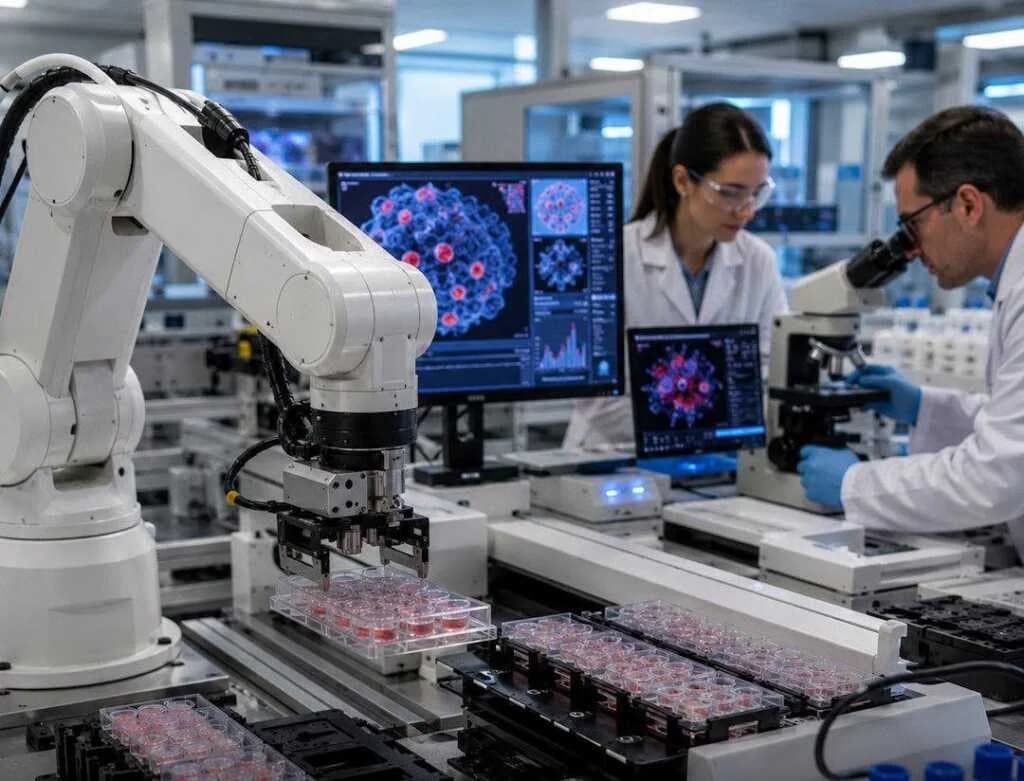
Scientists at the University of California, San Francisco (UCSF) have created the "world's first laboratory robotic system" to overcome cancer cells that recur even after the disease appears to be completely eradicated. These recurring cancer cells are called "persisters" - cells that survive treatment and resist being destroyed. They are extremely difficult to find because there is only about 1 in 1,000 cancer cells, and they can temporarily change their shape to avoid detection.
To overcome this challenge, researchers developed an automated robotic system that can automatically transfer thousands of tiny cancer tumors grown in the laboratory to drug testing areas, imaging systems, and analysis locations without human intervention, quickly and efficiently.
With the help of this robotic system, scientists were able to screen 94 experimental drug candidates in the blink of an eye - a process that would take months if done manually - and discovered 9 drugs that could potentially eliminate these resilient cancer cells at their roots.
This revealed that these highly resistant cells have common weaknesses, providing valuable clues for developing new treatments in the future that could prevent cancer recurrence.
This exciting research has been published in the Science Advances journal. However, since this is still in the early research stage within the laboratory, it is not yet a new treatment that can be directly applied to patients.
To actually use this method in hospitals with real patients and combat cancer completely, many more studies and medical trials with humans would need to be conducted.
Ref: Technology Innovation


